It looks like a sensible request. Bow makers are regularly asked for stiffer bows, and the request comes from three directions. Dealers favour them because a stiff bow wins the ten-minute trial: the player feels at once that he holds something. Teachers who work on the gesture favour them because a bow that obeys makes the gesture visible and correctable. Players favour them because they feel their own action in it. Each of these preferences is reasonable. Together they push students and performers toward the bow that costs them the most.
This note examines one parameter, the resistance of the stick; a good bow comes from combining it with all the others.
The cursor
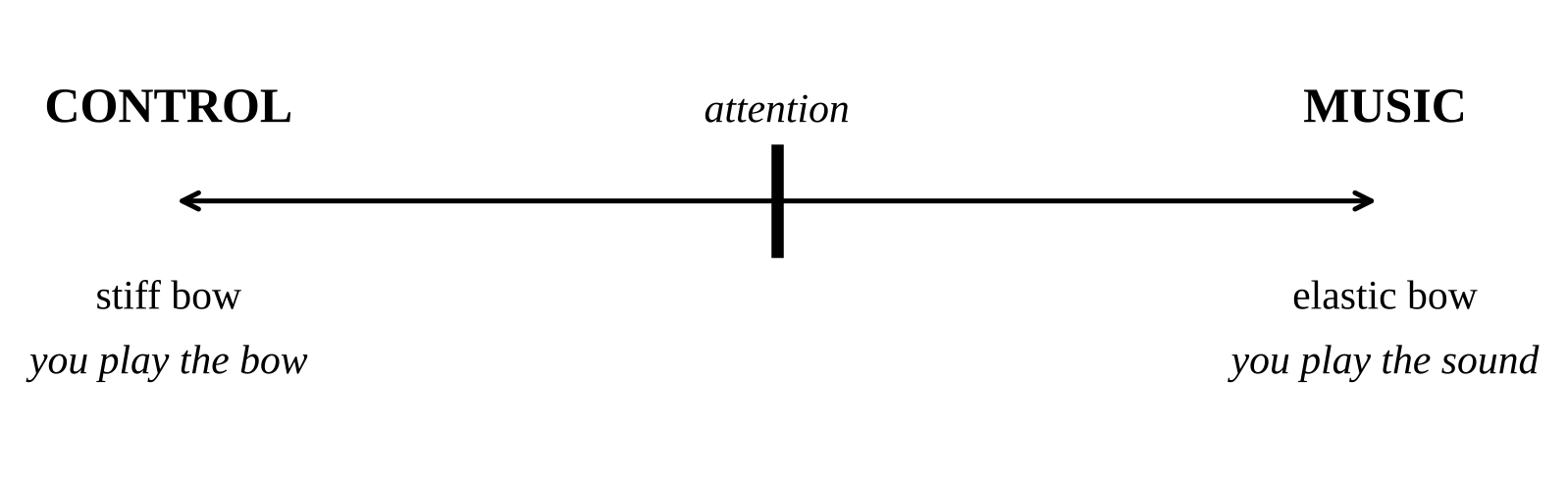
Where do you invest? A musician’s attention is a fixed budget. Every unit spent holding the bow is withdrawn from the music. Picture a cursor between two ends, control and music. A stiff bow moves it toward control: the player steers, presses, corrects. An elastic bow moves it toward music: the player intends, and the bow carries the intention to the string. The position of the cursor is set by the bow before the first lesson begins.
Behind the cursor lies a choice every musician faces: playing right or playing well. The more attention goes to gesture and placement, the more the neuromotor system takes accuracy as its goal. The more the gesture can be forgotten, the more attention is free for the musical message. Playing well means creating a direct link between thought and sound.
What happens under pressure
A bowed string does not vibrate continuously; it pulses. At every cycle the hair grips the string and carries it along, then the string releases, slides back and is gripped again. On an open A string this happens 440 times per second, and the quality of each release shapes the sound.
That release is preceded by a small reverse twist of the string, and this torsional motion can stabilise the vibration or disturb it. Mount a stiff stick with a standard frog and lean into it: a stick that refuses to yield transmits every fluctuation of pressure straight into the contact point. The release becomes irregular, and parasitic components appear.
Part of this noise is absorbed by the frog. What remains reaches the player’s ear, very close to the strings and the top, and the player reads it as power. Measured on the back of the instrument, the picture is different: the string system resists, and the body vibrates no more, if anything less. The player hears effort; the listener receives less. This is the trap of control: it produces the sensation of sound without the sound.
Where the elasticity goes
A bow is two springs in series, the stick and the hair. The stiffer the stick, the more the elasticity of the system rests on the hair alone. The stick stops taking part in the conversation with the string; the hair does what it can. The player, who senses the missing response, compensates with the arm. Elastic does not mean soft: an elastic stick stores and returns energy; a soft one loses it.
Tolerance is not stiffness
A stiff bow forgives excess pressure: the player can push harder before the sound collapses. This looks like kindness to the beginner, and it is the wrong kind. Forgiving the pressure maintains it. The student learns to press, the arm learns to hold, and the habit outlives the bow. What the beginner needs is a bow that tolerates imprecision in the gesture while still responding to a light hand: room to make mistakes, not a reason to push.
What the musician loses
Attention first, which leaves the music for the mechanics. Effort next, spent where it produces nothing the listener can hear. Then range: the dynamics, colours and sustained notes that a bow which plays makes available, and that a bow which must be controlled keeps out of reach.
Matching the bow to the musician
The point is to match the sensitivity of the bow to the musician’s capacity to let it play. The beginner’s bow should tolerate a margin of imprecision, giving the neuromotor system time to link what I want with what I must do to obtain it. As the musician progresses, the bow should move toward greater sensitivity, until it can be forgotten altogether and thought becomes sound in real time.
Checking it yourself
Take two bows, one stiff, one elastic. Play an open string slowly across the whole length without pressing, then with pressure. Then ask someone to cover your ears from behind while you play, so that you hear the room rather than the strings. The protocol How to Try a Bow describes these steps in detail.
The question to ask of a bow is simple: does it let me play, or does it ask me to control it?
With a stiff bow, you play the bow. With an elastic bow, you play the sound.
Sources
R. Mores, “Further empirical data for torsion on bowed strings”, PLOS ONE, 14(2), 2019. https://doi.org/10.1371/journal.pone.0211217
F. Ablitzer et al., “Influence of camber and hair tension on the static behaviour of the violin bow”.
L. Cremer, The Physics of the Violin, Cambridge (MA), MIT Press.
Gilles Saurais, L'archet, au cœur de l'acoustique, du geste et de la pédagogie, Lyon, Symétrie, 2026. English edition forthcoming.
How to cite this note
Saurais, Gilles (2026). “Let the Bow Play.” Isophonia Research Note No. 3, October 2026.
https://isophonia.org/let-the-bow-play.html